
Moving to Thailand? Declare Large Amounts of Cash at the Airport
Thai Customs arrested a passenger at Suvarnabhumi carrying undeclared pounds and dollars worth THB 2.58 million. Carrying cash into Thailand is legal, but above set limits you must declare it. Here are the limits, how to declare, and the simpler way to move your savings.
On 16 October 2026, Customs officers at Bangkok’s Suvarnabhumi Airport arrested an Indian man who had just arrived from Mumbai. According to the Customs Department, as reported by Nation Thailand, he was carrying 1,000 British £50 notes and 100 US$100 notes: £50,000 and US$10,000, which Customs valued at THB 2,578,690 as a preliminary estimate. None of it had been declared. Customs alleges that he broke the Finance Ministry’s exchange control rules and the Customs Act. These are allegations, and the report does not say what happens next.
Our take
Bringing money into Thailand is not a crime. The Bank of Thailand says foreign and Thai banknotes may be brought into the country without any limit. What gets people into trouble is failing to declare them. If you are moving here to retire, you may be tempted to carry savings for rent, a car or a deposit. Above certain amounts, a short form at the airport is the law. It is free and takes about 20 minutes.
The limits, in plain numbers
You must declare to Customs, when you arrive or when you leave, if you carry:
- foreign cash worth more than US$15,000 (or the same value in pounds, euros or any other currency);
- more than THB 450,000 in Thai baht cash; or
- Thai and foreign cash together worth more than THB 450,000.
The same limits apply to bearer cheques and similar instruments that do not name the person to be paid.
Taking baht out of Thailand has its own cap. You may take up to THB 50,000 to most countries, or up to THB 2 million to Cambodia, Laos, Malaysia, Myanmar, Vietnam and China’s Yunnan province. To take more, you need permission from the Bank of Thailand first.
How to declare
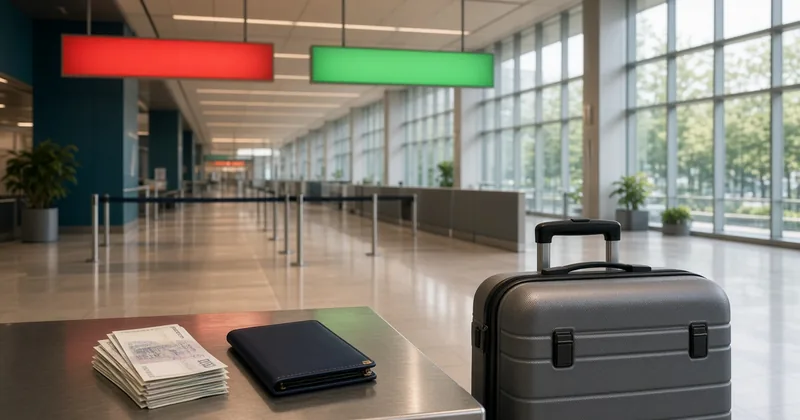
- Arriving: walk through the red channel (goods to declare), not the green one, and tell the Customs officer that you have cash to declare.
- Leaving: declare in person to a Customs officer at the airport before you fly.
- Have your passport ready. The officer gives you the declaration form, checks and counts the money with you, then signs and stamps the form and gives you a copy. Keep that copy.
- There is no fee. Customs says the whole process takes about 20 minutes. You can fill in the form online in advance, but you must still see an officer in person.
What happens if you don’t
Under the Exchange Control Act, breaking these rules can lead to a fine of up to THB 20,000, up to three years in prison, or both. The law also treats undeclared money as a restricted item under customs law. That gives Customs the power to search you, confiscate the money, arrest you and prosecute.
What this means for you
For most retirees, the best answer is not to carry large sums at all.
- Move your savings by bank transfer. Send money from your home bank to your Thai bank account. Thai banks must ask what an incoming transfer is for, so state the purpose clearly, for example living expenses or a visa deposit.
- Keep the paperwork. The Bank of Thailand says banks issue evidence of each foreign exchange transaction. Ask for it and keep it with your visa papers. For larger transfers your bank may also ask you to fill in a Foreign Exchange Transaction form, and for amounts of US$200,000 or more it will usually ask for documents showing where the money came from.
- Planning a retirement visa deposit? Our retirement visa guide sets out the amounts and how long the money must stay in the bank. Check those rules before you move any money.
- If you do carry cash, declare it. It costs nothing, and you leave with a stamped copy that shows the money came in legally.
Official sources
- Bank of Thailand, Exchange Control Regulation (sections 2.1, 7 and 8)
- Thai Customs Department, service manual on taking money into or out of Thailand (in Thai, updated February 2025)
- Civil Aviation Authority of Thailand, AIP GEN 1.3: entry and departure of passengers (customs channels and currency)
- Bank of Thailand, Exchange Control Act B.E. 2485, English translation (sections 8 and 8 bis)
- Thai Government, Procedure for accepting foreign money transfers (stating the purpose of a transfer)
- Ministry of Finance, Notification on Exchange Control (No. 6), 8 February 2017 (unofficial English translation)
Checked on 27 October 2026.
Source: Nation Thailand, 26 Oct 2026
Disclaimer. This article is general information only. It is not legal, tax, immigration or financial advice, and it does not create any adviser-client relationship. Rules change often, sometimes without notice, and officials apply them differently. Amounts and rules are correct to the best of our knowledge on the date shown. Always check the official source and talk to a qualified, licensed professional before you act. See our full Disclaimer.